

The Bureau du Roi: Louis XV’s desk that elevated the art of marquetry
Nine years of work, two of the greatest cabinetmakers in history, and a secret mechanism that locks every drawer with a single turn of a key. The Bureau du Roi, now kept at Versailles, remains the pinnacle of the art of marquetry — the very same art that, for over sixty years, has shaped every piece bearing the Marzorati name.
The story of the Bureau du Roi: from the court of Louis XV to Versailles
In 1760, Louis XV commissioned court cabinetmaker Jean-François Oeben to create an unprecedented piece of furniture: a desk that would let him work away from prying eyes, with state documents always kept safe. Oeben, master cabinetmaker of the Royal Arsenal, began with a small wax model to study every proportion before carving a single millimetre of real wood, and worked on the project for three years, experimenting with mechanisms and marquetry never attempted before on a piece of this scale. He died in 1763, without ever seeing it finished.
His legacy passed to Jean-Henri Riesener, Oeben’s apprentice and the future husband of his widow – the very same Riesener who would go on to become Marie Antoinette’s favourite cabinetmaker. The Bureau du Roi was delivered in May 1769, after nine uninterrupted years of work: it cost 62,775 livres in gold, the highest price ever paid for a piece of furniture during the entire reign of Louis XV. It remains on display today in the Palace of Versailles: not a copy, not a reconstruction, but the very original that has survived more than two and a half centuries of European history.
- 1760 – Louis XV commissions the piece from Jean-François Oeben, who begins with a small wax model
- 1763 – Oeben dies; the project passes to his apprentice, Jean-Henri Riesener
- 1769 – The Bureau du Roi is delivered to Versailles: it costs 62,775 livres in gold, a record price for a piece of furniture
- 1770 – Louis XV dies just one year after receiving the desk; the bust dedicated to him among the bronzes is replaced with one of Minerva
- 1791 – The desk escapes the revolutionary sales thanks to the magnificence of its decoration
- Today – Since 1957 it has returned to its place in the Palace of Versailles, a treasure of the world’s cabinetmaking heritage
Why the Bureau du Roi still fascinates today
The art of marquetry in the Bureau du Roi: technique and materials
What makes the Bureau du Roi an absolute masterpiece isn’t just its history, but the technique that covers it entirely: hundreds of tiny pieces of fine wood, hand-cut and fitted together one by one to form trophies, floral garlands and allegories of the arts and sciences. The hardest technical challenge lies precisely in the rolling cylinder: the marquetry has to follow a curved surface while remaining perfectly continuous, with no visible breaks, even as the mechanism is in motion.
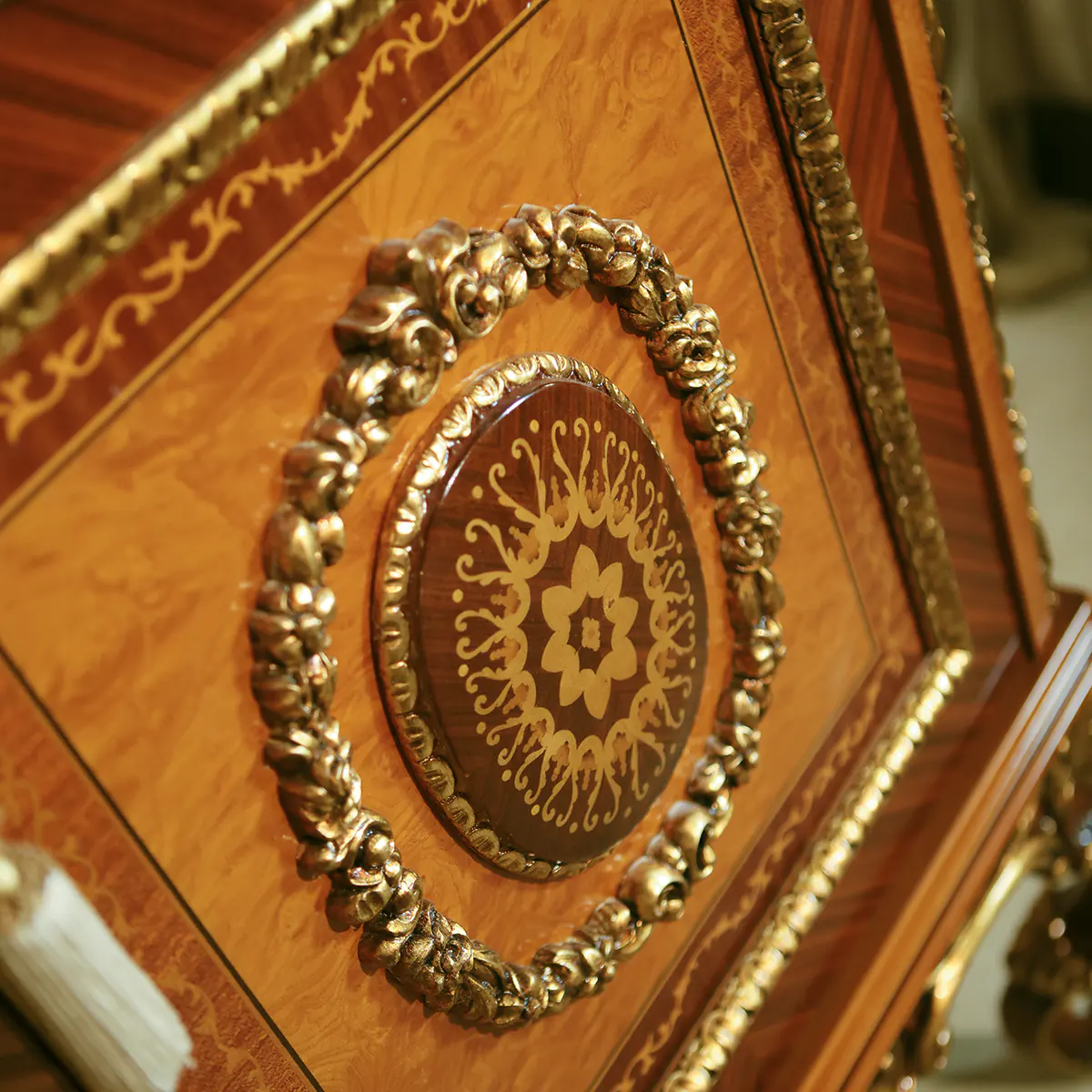
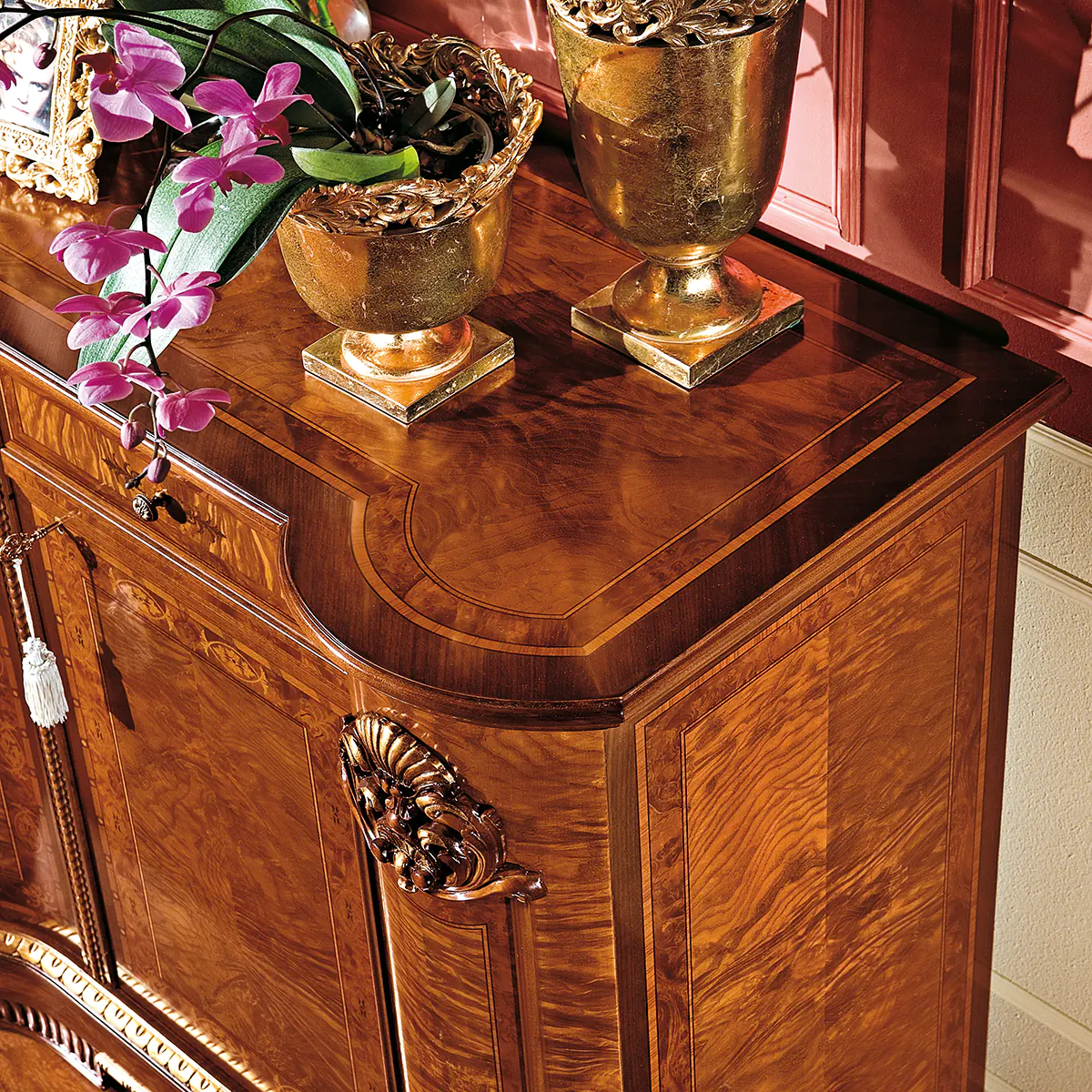
It’s the very same discipline – patience, millimetre precision, a deep knowledge of the material – that still animates every artisan cabinetmaking workshop today, including ours. Classic marquetry is built by selecting timbers of different colour and grain, then cutting and inlaying them to form patterns, borders and decorative motifs that become a structural part of the piece itself, not mere surface ornament.
- Amaranth – intense violet tones, used for bold contrasts
- Kingwood and rosewood – warm grains for trophies and borders
- Sycamore and boxwood – light tones for highlights and fine details
- Burl and ebony – depth and richness in backgrounds and dark fields
From Versailles to Brianza: Italy’s marquetry heritage
While French court cabinetmakers were perfecting their craft for Versailles, Italy had already been guarding its own, parallel tradition of marquetry for centuries: born in the Renaissance workshops of Lombardy and refined generation after generation in the artisan workshops of Brianza, Italy’s cradle of designer furniture. Marzorati was born in that very same tradition: over sixty years of solid-wood craftsmanship, of marquetry drawn and composed by hand, of artisan know-how passed down from master to apprentice.
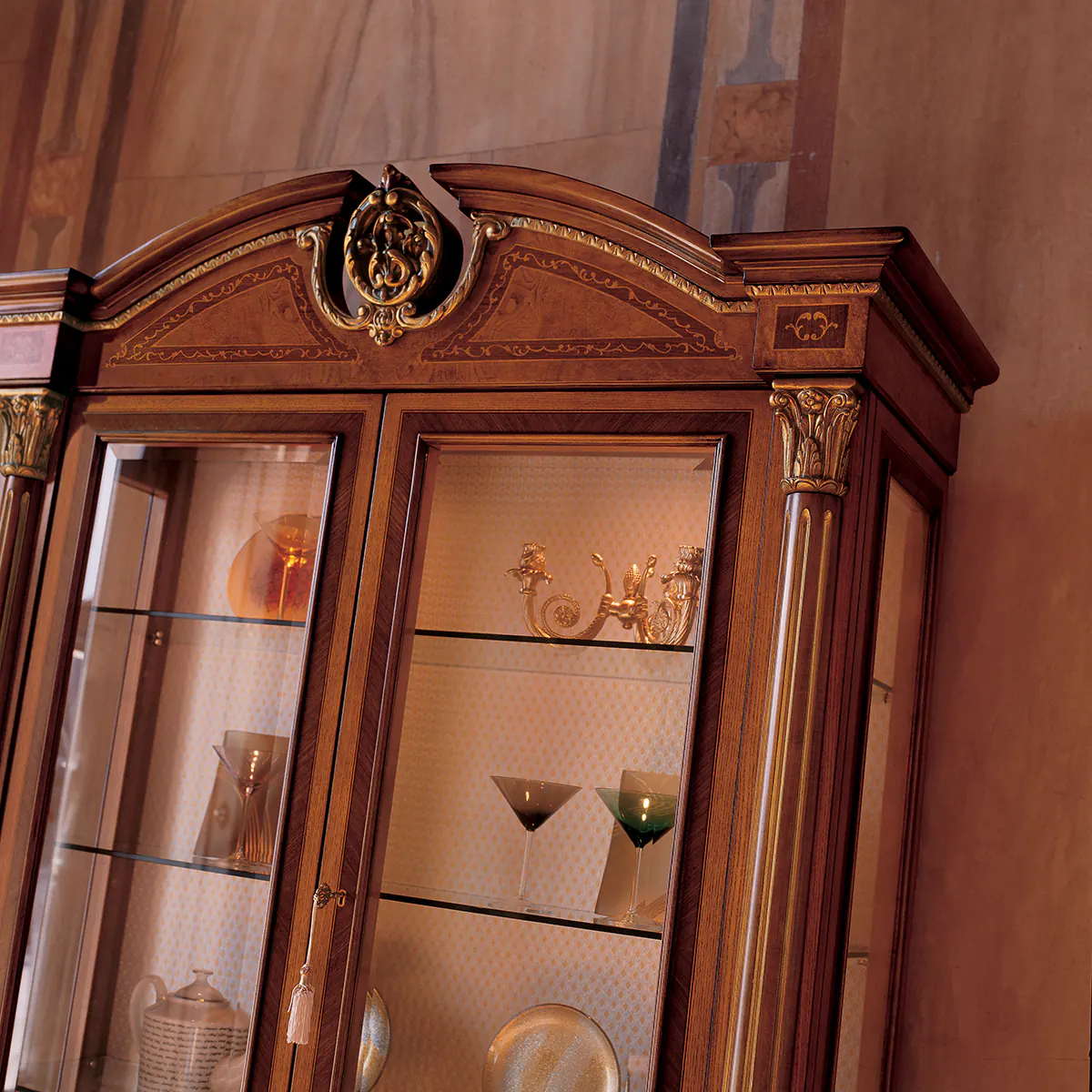
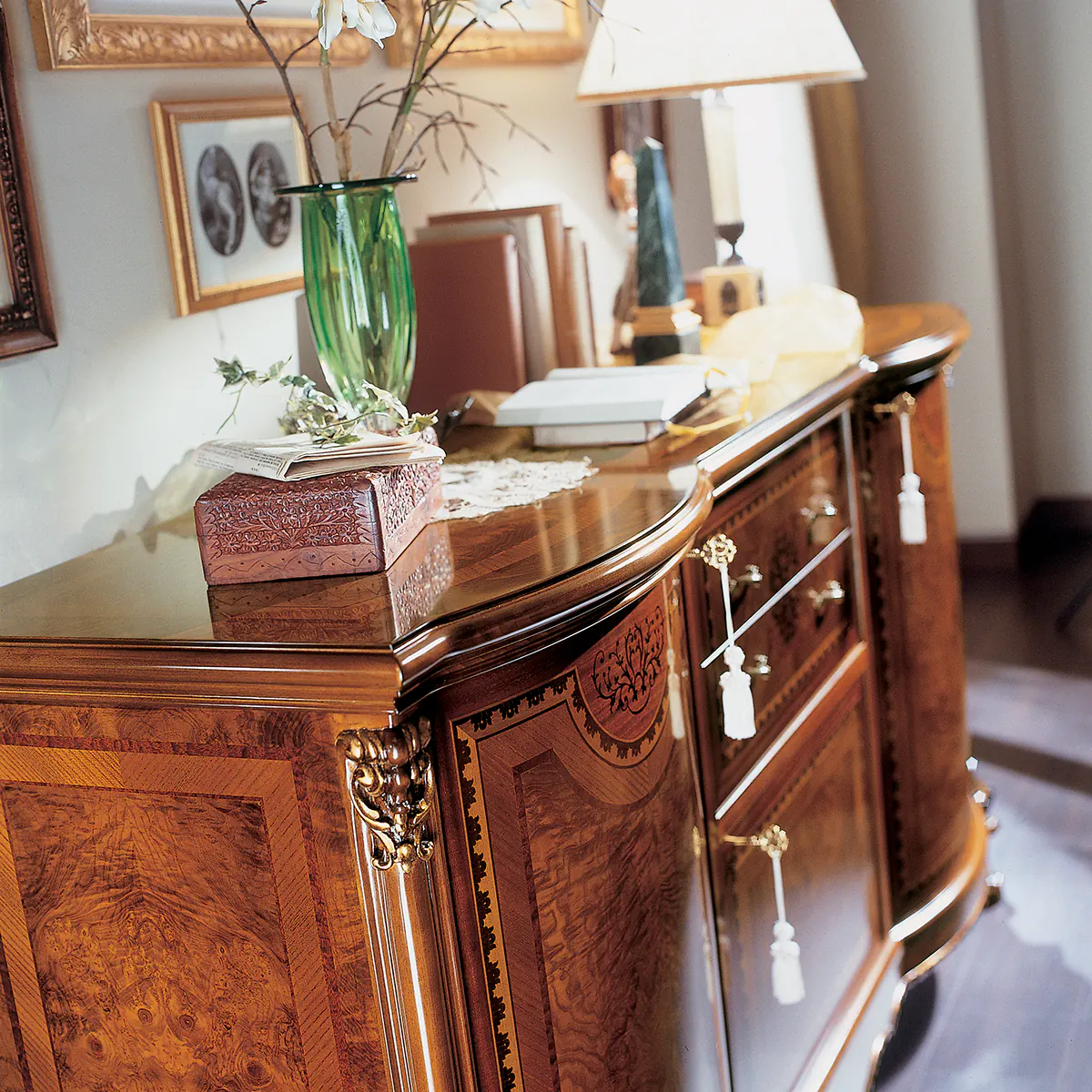
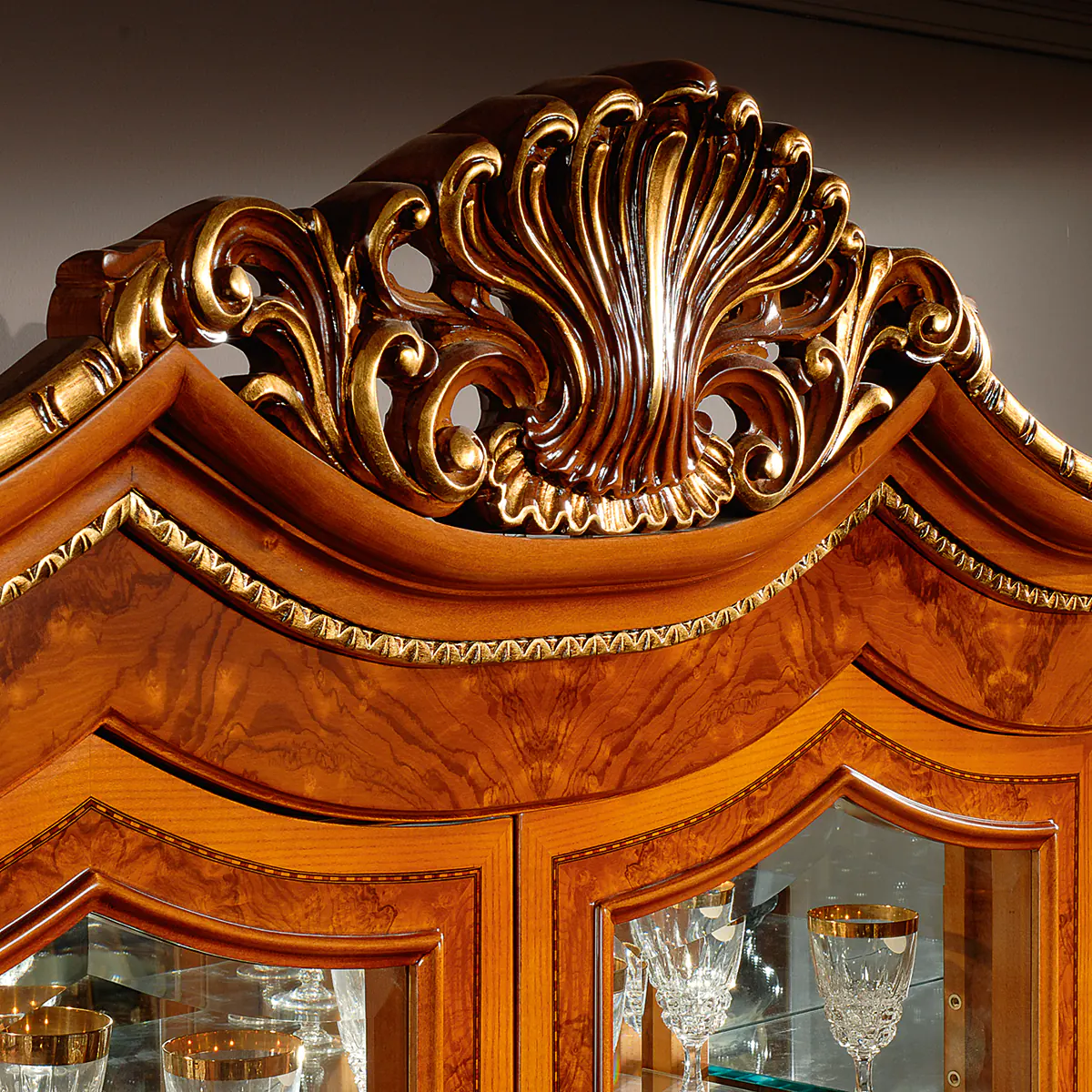
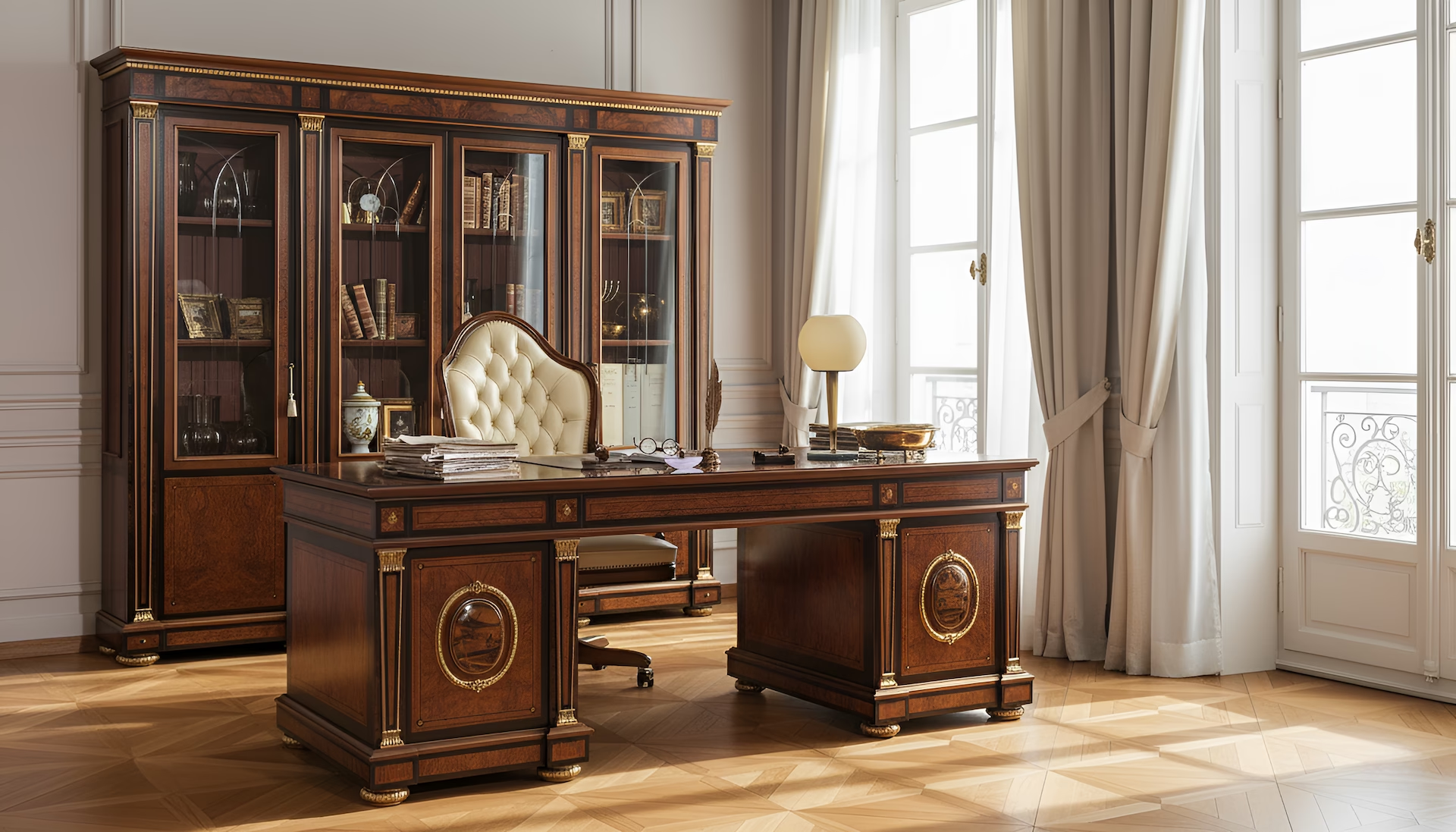
We don’t reproduce the Bureau du Roi: we draw inspiration from its spirit. From the same obsession with detail, the same idea that a piece of furniture can be both a functional object and a work of art, capable of crossing generations. That’s why our classic collections speak the same language: fine woods, marquetry executed entirely by hand, timeless forms designed for those who love antiques and recognise, in a piece of furniture, the value of true craftsmanship.
Anecdotes and legends of the Bureau du Roi
Behind the inlaid surface of the Bureau du Roi lie episodes that could have come straight out of a historical novel: a bust hastily replaced, a signature that changed the fate of a continent, a disguise that saved a masterpiece from revolutionary fury.
Our collections, inspired by the art of classic marquetry
Six classic collections, six different ways of interpreting the same art: hand-made, bespoke marquetry, for those who furnish spaces where history feels at home. Discover which collection best tells the story of your project.